“They’re renewing my faith in British Theatre” - Roy Williams on mentoring the next generation of writers
1 Apr 2026
Simply put, Roy Williams OBE is a bit of a living legend. The multi award-winning writer whose work includes The Lonely Londoners (Jermyn Street/Kiln), Death of England: The Plays (National Theatre), Sucker Punch (Royal Court), as well as BBC Radio 3 audio drama Gatsby in Harlem (Audio of the Year and Best Audio Drama at the 2025 British Audio Awards), is firmly established at the forefront of new British writing talent. But in his role as Distinguished Visiting Artist on Mountview’s MA/MFA Creative Practice courses, he’s currently focussed on mentoring and supporting the next generation of playwrights studying on the Dramatic Writing pathway.
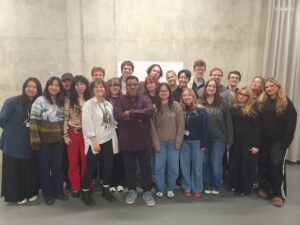
“It’s fun for me!” he says, grinning widely, “Those are my favourite moments – asking fellow writers ‘So what are you working on? How’s it going? What’s your play about? What do you want to say?’ I want to be inspired by people – whether they’re at the beginning of their career or more established.”
Finding sources of inspiration for the students is a big part of Roy’s role within the course, particularly through the regular Masterclasses he arranges. Previous speakers have included Hettie McDonald (Director of Normal People, BBC) and Jon Brittain (Olivier award-winning writer of Rotterdam, Theatre 503/West End), with more to come. For Roy, much of the joy comes from the simplicity of the format. “It’s very relaxed, just me and the guest and the students. It’s the best way of learning, hearing from inspiring people who are out there actually doing it.” That said, he’s eager to stress that this isn’t a dictatorial process. “It’s not about them saying ‘It’s my way or no way’, definitely not” continues Roy, “The focus is on ‘this is my truth as I’ve personally experienced it and understand it – take what you like from that, or don’t.”
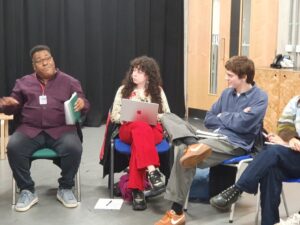 For Eddie, part of the current Dramatic Writing cohort, this is reflected in his experience of the course. “It’s honestly been the case that every guest who’s come in has just treated us like peers and as writers – not as students of writing” Eddie explains, “There’s been no instance where we’ve been talked down to or made to feel that we’re not yet writers. I’ve never felt so taken seriously as a creative and to feel that my voice and my ideas matter.”
Acting as a source of support and mentorship for his students is clearly important to Roy. Though writing is innately solitary, he stresses the importance of writers having a collective space where they can just write and not be judged, with the security to explore their ideas and develop as creatives. “I always say that the first draft of a play is about you just writing it” Roy explains, “Then the second draft is about finding a play you want to write out of the play already written. Just get to the end and then go back – ultimately all good writing is about rewriting.”
Roy and his students have clearly developed a great rapport. “I don’t know if you remember, but we were really scared to meet you at the beginning…” admits Eddie, “Because obviously we were, come on! And then it turns out he’s the nicest man in the world. I just think it’s been awesome.”
Along with another fellow student Dillon, the two launch into a list of guest tutor highlights – Leo Butler (“he basically ran a writer’s group with us, it was incredible”), Yasmin Joseph (“we literally demanded that she came back again, because she was so amazing”), Stef Smith (“she really put us through our paces”), Deborah Pearson (“totally changed how I thought about performance and concept art”), Emma Dennis-Edwards (“incredible, unbelievable – what an amazing woman”) and Sami Ibrahim (“I genuinely think he might have the best taste in plays of anyone I’ve ever met”).
As the conversation shifts to talking about next steps, the students are full of plans for after their time at Mountview finishes. Both are (in Eddie’s words) “looking forward to just cracking on”. Dillon is planning to spend some time honing his craft but also admits that the course has opened other creative pathways
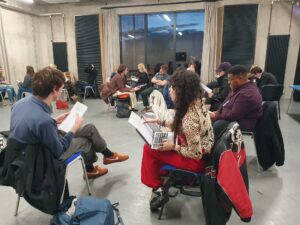
– “I came in set on theatre, but since doing sessions on TV I’ve become really excited by the prospect of that.” Eddie, who previously worked in education, already has a show that he is eager to take out on a school’s tour along with an accompanying writing workshop. He’s also keen to get into script reading and “be inspired by other people’s new work”. But most importantly and throughout it all, to “just keep writing”.
As Dillon and Eddie ask about their mentor’s latest project, Roy is open but tight-lipped. “It’s like we said earlier, I haven’t quite found the play I want to write yet” he says, “It’s still running around my head, just words. It’s got to be a mess initially – and then you pull things out, put things back in, shift it around. So that’s me right now, I’m there. And I wouldn’t have it any other way.”
